
Effective teaching involves more than explaining concepts and assigning work. Teachers also need to understand what students are learning, where they are experiencing difficulties, and which instructional approaches will help them make progress. Formative assessment provides a practical way to gather this information throughout the learning process.
By using formative assessment strategies, teachers can identify misunderstandings early, provide meaningful feedback, adjust lesson plans, and help students take greater responsibility for their learning. These strategies can be used in elementary schools, middle schools, high schools, and other educational settings without requiring expensive technology or lengthy examinations.
Formative assessment is most effective when it becomes part of everyday classroom instruction. A carefully chosen question, a short written response, a classroom discussion, or an exit ticket can reveal valuable information about student understanding. Teachers can then use that evidence to decide what to explain again, which students need additional support, and when the class is ready to move forward.
This guide explains what formative assessment is, why it matters, and how teachers can apply practical assessment techniques to improve classroom learning.
What Is Formative Assessment?
Formative assessment is an ongoing process of gathering and using evidence of student learning to guide teaching and improve understanding. It helps teachers identify what students know, what they misunderstand, and what they need to learn next.
Unlike an assessment used primarily to assign a final grade, formative assessment focuses on improvement during learning. Its value comes from how teachers and students use the information to determine the next steps.
For example, a teacher introducing fractions might ask students to represent one-half using a diagram. If several students shade the wrong portion of a shape, the teacher can revisit the relationship between equal parts and fractional values before introducing more complicated problems.
Formative assessment can take many forms, including:
- Short quizzes and practice questions.
- Classroom discussions and targeted questioning.
- Exit tickets and written reflections.
- Teacher observations during group activities.
- Student self-assessment.
- Peer feedback.
- Draft assignments and revision activities.
- Concept maps and graphic organizers.
- Demonstrations, presentations, and practical tasks.
A quiz does not automatically become formative simply because it is short or ungraded. It becomes formative when the results are interpreted and used to improve teaching or learning.
Why Is Formative Assessment Important in the Classroom?
Students can appear to understand a lesson while still having misconceptions or gaps in their knowledge. Regular assessment gives teachers opportunities to check understanding before those difficulties become more challenging to address.
1. Identifies Learning Gaps Early
Formative assessment helps teachers discover which concepts students understand and which require further explanation.
For example, a student may memorize a mathematical formula without understanding when to apply it. A carefully designed question that requires the student to explain the reasoning can reveal this gap.
Early identification allows teachers to provide targeted instruction instead of waiting until a major test reveals the problem.
2. Improves Teaching Decisions
Assessment results can help teachers determine whether to continue with a lesson, revisit a concept, change an explanation, or provide more practice.
If most students answer a question incorrectly, the teacher may need to explain the concept differently. If only a small group struggles, targeted small-group instruction may be more appropriate.
This makes lesson planning more responsive to students’ actual needs.
3. Provides Meaningful Feedback
Students benefit from feedback that explains what they have done well and how they can improve.
Instead of writing “Incorrect” on a student’s response, a teacher might explain, “You selected the correct operation, but check how you placed the decimal point in your final answer.”
Specific feedback helps students understand their mistakes and gives them a practical next step.
4. Encourages Active Student Participation
When students regularly answer questions, explain their reasoning, review examples, and reflect on their progress, they become active participants in the learning process.
These activities can also help teachers hear from students who may not normally volunteer answers during whole-class discussions.
5. Builds Student Confidence and Independence
Formative assessment can help students recognize progress, identify personal learning goals, and understand that mistakes are opportunities to improve.
When assessment is supportive rather than punitive, students may become more willing to ask questions, revise their work, and try challenging tasks.
6. Supports More Inclusive Instruction
Students have different levels of prior knowledge, language proficiency, confidence, and familiarity with academic tasks. Regular assessment helps teachers identify these differences and make appropriate adjustments.
Teachers can provide additional examples, vocabulary support, alternative explanations, guided practice, or enrichment activities while maintaining meaningful learning expectations.
10 Effective Formative Assessment Strategies for Teachers
The most useful strategies are practical, connected to the lesson objective, and easy to interpret. Teachers should choose assessment techniques that reveal the kind of understanding they need to evaluate.
1. Use Exit Tickets at the End of Lessons
An exit ticket is a short activity students complete near the end of a lesson. It allows teachers to check what students have learned and identify questions that need attention.
An effective exit ticket usually contains one to three focused questions rather than a long test.
For example, after a science lesson about the water cycle, students might answer:
- What is evaporation?
- How is evaporation different from condensation?
- Which part of the water cycle is still unclear to you?
The teacher reviews the responses to identify common misunderstandings and plan the next lesson.
Exit tickets work well because they require little preparation and can provide useful evidence from the whole class. Their effectiveness depends on reviewing the answers and acting on the information.
2. Ask Questions That Reveal Student Thinking
Questioning is one of the simplest ways to assess understanding during instruction. However, questions should go beyond checking whether students can remember a fact.
Teachers can ask learners to explain a process, justify an answer, compare two ideas, or identify an error.
For example, instead of asking only, “What is the answer to this problem?” a mathematics teacher might ask, “How did you reach that answer, and why did you choose that method?”
Useful follow-up questions include:
- What evidence supports your answer?
- Can you explain that in another way?
- What mistake might someone make here?
- How would your answer change if one condition changed?
- Can you find another method to solve the problem?
These questions help teachers understand students’ reasoning and distinguish a genuine understanding from a correct guess.
3. Conduct Quick, Low-Stakes Quizzes
Short quizzes can help teachers check knowledge of important concepts without creating the pressure associated with major examinations.
A quiz might include three multiple-choice questions, a short calculation, a vocabulary check, or one explanation question.
For example, after teaching the difference between nouns and verbs, an English teacher could ask students to identify the word types in several sentences.
The teacher can then review the answers and determine whether students need further practice.
To make quizzes useful for formative assessment:
- Keep the questions aligned with the learning objective.
- Include common misconceptions in the answer options when appropriate.
- Review incorrect responses to identify patterns.
- Give students a chance to correct their mistakes.
- Use the results to plan subsequent instruction.
The goal is to discover what students need next, not simply to produce another score.
4. Use Think-Pair-Share Activities
Think-pair-share gives students time to consider a question independently, discuss their ideas with a partner, and share conclusions with the class.
This strategy can help teachers assess understanding while encouraging participation.
For example, during a social studies lesson, ask students to explain one cause of a historical event. Give them a short period to write their ideas, discuss them with a partner, and then share selected responses.
As students talk, the teacher can listen for accurate explanations, incomplete reasoning, and misconceptions.
To strengthen the assessment value, ask students to explain why they reached a conclusion rather than simply state an answer. Teachers can also invite pairs to revise their explanations after hearing another perspective.
5. Use Traffic-Light Self-Assessment
Traffic-light self-assessment allows students to communicate how confident they feel about a learning objective.
Students can use three categories:
- Green: I understand the concept and can apply it independently.
- Yellow: I understand some of it but need more practice.
- Red: I need additional explanation or support.
For example, after a lesson on fractions, students indicate their confidence in comparing fractions with different denominators.
The teacher can use this information to decide where to provide support. However, self-reported confidence should not be treated as proof of mastery. A student may feel confident while holding a misconception, or feel uncertain despite answering questions correctly.
Combine confidence ratings with a short task or question to obtain a clearer picture of learning.
6. Provide Timely, Actionable Feedback
Feedback is an essential part of formative assessment because it tells students how to improve their work.
Effective feedback is specific, understandable, connected to the learning objective, and focused on actions students can take.
For example:
Instead of: “Your paragraph needs improvement.”
Try: “Your paragraph has a clear topic sentence. Add two relevant details and explain how each detail supports your main idea.”
Instead of: “Study harder.”
Try: “Review the difference between evaporation and condensation, then answer these two practice questions.”
Teachers should also provide time for students to use the feedback. Asking learners to revise one answer, improve a paragraph, or correct a calculation helps turn feedback into a learning opportunity.
7. Use Peer Assessment With Clear Criteria
Peer assessment allows students to review one another’s work using agreed-upon criteria. It can help learners recognize quality, explain their thinking, and identify possible improvements.
For example, students writing persuasive paragraphs might exchange drafts and use a short checklist:
- Does the paragraph state a clear opinion?
- Does it provide relevant evidence?
- Does it explain the evidence?
- Is the conclusion connected to the main argument?
Teachers should model constructive feedback before introducing peer review. Students need to understand how to comment on the work respectfully and specifically.
Peer assessment should support learning rather than replace teacher judgment, particularly when tasks involve complex skills or sensitive feedback.
8. Observe Students During Classroom Activities
Not all assessment requires a written test. Teacher observation can provide valuable evidence while students work independently, participate in group tasks, or complete practical activities.
During a science investigation, for example, a teacher might observe whether students can identify variables, follow procedures, record results, and explain what the evidence suggests.
A simple observation checklist can help the teacher record specific skills or difficulties.
For observation to be useful, focus on the learning objective. Rather than recording general impressions such as “good participation,” note observable evidence, such as “correctly identifies the independent variable but cannot yet explain how it affects the outcome.”
These notes can guide feedback, small-group instruction, and future lesson planning.
9. Use Concept Maps and Graphic Organizers
Concept maps and graphic organizers help students show relationships between ideas. They are especially useful when learning involves connected concepts, categories, processes, or cause-and-effect relationships.
For example, students studying ecosystems might create a concept map linking producers, consumers, decomposers, energy, and food chains.
The teacher can examine the map to see whether students understand how the concepts connect.
Graphic organizers can also support:
- Comparing and contrasting two ideas.
- Sequencing events.
- Organizing evidence for an essay.
- Explaining a scientific process.
- Identifying causes and consequences.
- Connecting vocabulary to examples.
Look for missing connections, inaccurate relationships, and incomplete explanations. These patterns often reveal more than a list of correct definitions.
10. Use the “One-Minute Paper”
A one-minute paper asks students to respond briefly to a focused question before the lesson ends.
Possible prompts include:
- What was the most important idea you learned today?
- What question do you still have?
- Which step was most difficult, and why?
- How would you explain today’s concept to another student?
- What is one example that demonstrates your understanding?
This strategy helps students reflect on learning while giving teachers a quick overview of the class’s progress.
Review responses for recurring themes rather than trying to provide lengthy written comments on every paper. If many students identify the same difficulty, address it in the next lesson.
How to Use Formative Assessment Results to Improve Teaching
Collecting assessment information is only the first step. Teachers need a clear process for interpreting the evidence and deciding what to do next.
Step 1: Identify the Learning Objective
Before choosing an assessment, decide what students should know or be able to do.
For example, “Students will explain how supporting details strengthen a paragraph” is more useful than a broad objective such as “Students will understand writing.”
A clear objective helps teachers design questions that measure the intended learning.
Step 2: Choose an Assessment That Matches the Objective
Select a task that reveals the specific skill or knowledge you want to assess.
If students need to explain a process, a question requiring an explanation may be more useful than a multiple-choice question alone. If the objective involves performing a calculation, ask students to solve a problem and show their steps.
The assessment should provide evidence that is relevant to the learning goal.
Step 3: Look for Patterns in Student Responses
After collecting responses, identify common strengths, mistakes, and misconceptions.
For example, if several students choose the correct mathematical operation but make the same calculation error, they may need targeted practice with that step rather than a complete reteaching of the topic.
If students make different errors, the teacher may need to provide different forms of support.
Step 4: Adjust Instruction
Use the evidence to determine the next instructional action.
| Assessment finding | Possible teaching response |
|---|---|
| Most students understand the concept | Continue to the next learning step |
| Many students share the same misconception | Re-explain the concept using a different example |
| A small group needs additional support | Provide focused small-group instruction |
| Students understand the basics but struggle to apply them | Model an application and provide guided practice |
| Some students demonstrate secure understanding | Offer a meaningful extension task |
These are starting points rather than rigid rules. Teachers should consider the difficulty of the concept, the quality of the assessment, and the learning needs of the students.
Step 5: Give Students Time to Act on Feedback
Explain what students did well, identify the next improvement, and provide time to make that improvement.
For example, after a writing assessment, students might revise their topic sentences using teacher feedback. After a mathematics quiz, they might correct errors and explain the correct method.
This step closes the feedback loop and gives teachers another opportunity to check whether learning has improved.
Step 6: Reassess Understanding
After additional teaching or practice, ask a new question or provide a similar task to see whether students have made progress.
Avoid simply repeating the same question if students may remember the answer without understanding the underlying concept. A slightly different example can help reveal whether they can apply the learning independently.
A Practical Example of Formative Assessment in a Lesson
Consider a Grade 6 mathematics lesson with the objective of helping students add fractions with different denominators.
Before instruction: The teacher gives students two short problems involving equivalent fractions. The responses show that several students do not understand how to find equivalent fractions.
During instruction: The teacher models the use of visual fraction diagrams and demonstrates how to create equivalent fractions with a common denominator.
Guided practice: Students solve a problem independently and show their working. The teacher checks their responses and notices that most students understand the first step but some still add the denominators incorrectly.
Targeted feedback: The teacher uses a visual example to explain why the denominators represent the size of the parts and should not simply be added.
Follow-up assessment: Students solve a new problem and explain why a common denominator is needed.
Next lesson: The teacher reviews the new responses. Students who demonstrate understanding move on to more complex problems, while those who still need support receive additional guided practice.
This example illustrates how formative assessment can guide instruction throughout a lesson instead of being limited to a test at the end of a unit.
Formative Assessment Examples for Different Subjects
Formative assessment should reflect the skills students are learning. A strategy that works well for one subject may need to be adapted for another.
Formative Assessment in English and Reading
English teachers can use reading-response questions, draft paragraphs, vocabulary checks, peer review, and short oral explanations.
After a reading activity, students might identify the main idea and select two supporting details. Their responses help the teacher determine whether they understand the text or need additional support distinguishing important information from minor details.
During writing lessons, reviewing a paragraph draft can reveal whether students need help with organization, evidence, sentence structure, or grammar.
Formative Assessment in Mathematics
Mathematics teachers can use worked examples, mini whiteboards, quick quizzes, error analysis, and student explanations.
For example, ask students to solve a percentage problem and explain their method. If the final answer is incorrect, the teacher can examine the steps to determine whether the difficulty involves identifying the percentage, setting up the calculation, or performing the arithmetic.
This makes it easier to provide precise feedback.
Formative Assessment in Science
Science teachers can assess learning through predictions, labelled diagrams, observation records, investigation plans, and explanations of results.
Before a demonstration, students might predict what will happen and explain their reasoning. After observing the result, they can compare the evidence with their prediction.
The teacher can then identify whether students understand the scientific concept or need to revisit the explanation.
Formative Assessment in Social Studies
Social studies teachers can use timelines, source analysis, short written explanations, map activities, and structured discussions.
After studying a historical event, students might identify one cause and explain how it contributed to the outcome. Their responses help the teacher assess whether students understand relationships between events rather than simply memorizing dates.
Formative Assessment in Early Childhood Education
For younger learners, assessment can include observation, guided play, conversations, picture sorting, demonstrations, and simple learning portfolios.
A teacher helping children develop counting skills might observe whether they can count objects accurately, match numbers to quantities, and recognize when an object has been counted twice.
Activities should be suitable for children’s developmental stages and should provide useful information without creating unnecessary testing pressure.
How Technology Can Support Formative Assessment
Digital tools can make it easier to collect responses, identify patterns, and provide feedback. However, effective formative assessment depends on instructional decisions, not on the technology itself.
Teachers may use digital quizzes, classroom polling tools, shared documents, learning platforms, or interactive practice activities to check understanding.
For example, a teacher can ask students to answer a multiple-choice question using a classroom polling tool. If many students select the same incorrect answer, the teacher can pause and address the misconception immediately.
Digital tools may also help teachers:
- Collect responses from an entire class.
- Provide immediate feedback on practice questions.
- Track progress across multiple lessons.
- Share comments on student drafts.
- Offer additional practice based on identified needs.
- Give students opportunities to reflect on their progress.
Teachers should consider accessibility, student privacy, device availability, and the reliability of the information collected. Paper-based methods and classroom discussion remain useful alternatives when digital access is limited.
Common Formative Assessment Mistakes to Avoid
Even a well-designed assessment may have limited value if teachers use the results incorrectly. Avoiding common mistakes can make classroom assessment more effective.
Using Too Many Assessments
Frequent assessment is useful when it provides meaningful information, but constant testing can interrupt instruction and create unnecessary workload.
Choose short assessments that answer a specific question about student learning. A well-designed question may provide more useful information than a long quiz.
Focusing Only on Correct or Incorrect Answers
An incorrect answer does not always reveal the underlying problem. Students may misunderstand a concept, misread a question, or make a calculation error.
Ask students to explain their reasoning or show their working when the learning objective requires it.
Providing Feedback Without Follow-Up
Feedback is less useful when students do not have an opportunity to act on it. Build time into lessons for corrections, revisions, additional practice, or reflection.
Using Assessment Only to Assign Grades
Formative assessment should primarily guide improvement during learning. If every classroom check becomes a graded event, students may focus on protecting their scores instead of revealing what they do not yet understand.
Ignoring the Results
Collecting exit tickets, quiz responses, or observation notes without reviewing them creates extra work without providing the intended benefit.
Decide in advance how the information will inform the next lesson, group activity, or feedback opportunity.
Relying on a Few Volunteers
When only the most confident students answer questions, teachers may gain an incomplete picture of class understanding.
Use strategies that allow everyone to respond, such as individual written answers, mini whiteboards, quick polls, or short partner discussions followed by individual checks.
How to Make Formative Assessment Manageable for Teachers
Teachers often have limited time for lesson preparation, marking, and individual support. Formative assessment can remain practical when it is built into ordinary teaching routines.
Use short assessment activities. One focused question at the right moment can reveal whether students are ready to proceed.
Reuse assessment templates. Prepare reusable exit tickets, checklists, and reflection prompts that can be adapted for different topics.
Focus on common misconceptions. Identify errors that affect learning across the class and address them through targeted explanations.
Use whole-class feedback when appropriate. If many students make the same mistake, a brief class discussion may be more effective than writing the same comment on every assignment.
Teach students to assess their own work. Clear success criteria and simple checklists help learners identify errors before submitting assignments.
Collaborate with colleagues. Teachers can share assessment questions, discuss student responses, and develop common approaches to important learning objectives.
Keep records simple. Brief notes about common strengths, misconceptions, and next steps may be sufficient for everyday lesson planning.
The goal is not to collect the maximum amount of information. It is to gather enough useful evidence to make better decisions about teaching and learning.
How to Measure Whether Formative Assessment Is Improving Learning
Teachers can evaluate the effectiveness of formative assessment by checking whether students make progress toward the intended learning objectives.
Useful indicators include:
- Improved accuracy on similar tasks.
- Clearer explanations of concepts.
- Fewer recurring misconceptions.
- Greater ability to complete tasks independently.
- Better use of feedback in revised work.
- More accurate student self-assessment.
- Increased participation in learning activities.
Compare student work over time rather than relying on one quiz or one classroom observation. Consider whether students can apply their understanding to a new example, not merely repeat a previously practised answer.
If progress remains limited, review the assessment itself. The questions may be unclear, the learning objective may need to be broken into smaller steps, or the teaching response may not address the underlying difficulty.
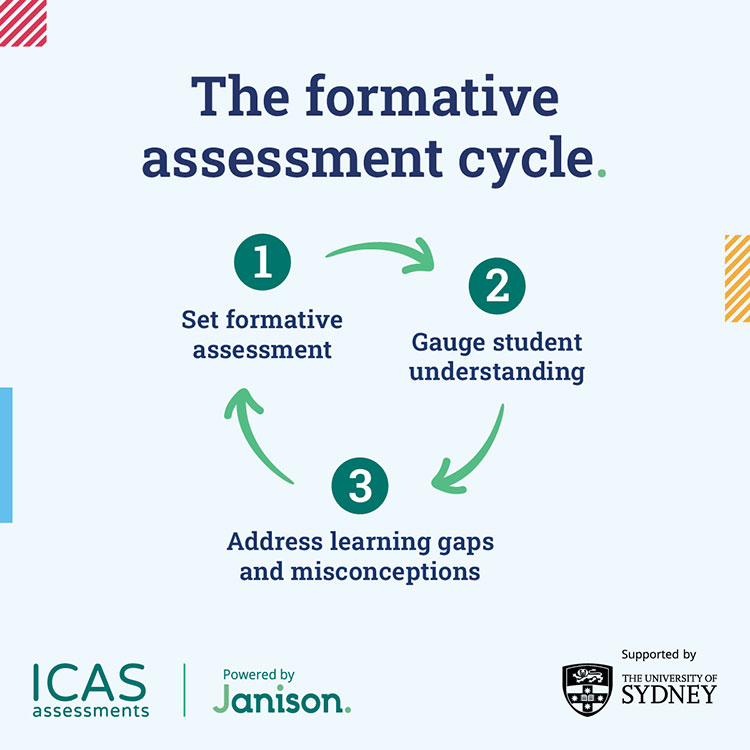
Formative assessment is an ongoing cycle of evidence, interpretation, feedback, instructional adjustment, and reassessment. Regularly reviewing this cycle helps teachers improve both their teaching practices and students’ learning experiences.
Frequently Asked Questions About Formative Assessment
What are the best formative assessment strategies?
Useful strategies include exit tickets, targeted questioning, low-stakes quizzes, think-pair-share, peer assessment, student self-assessment, concept maps, classroom observations, and actionable feedback. The most appropriate strategy depends on the learning objective and the evidence a teacher needs to collect.
What is the main purpose of formative assessment?
The main purpose is to improve learning while instruction is taking place. Teachers use evidence of student understanding to identify learning gaps, provide feedback, and decide what teaching or practice should happen next.
What is the difference between formative and summative assessment?
Formative assessment is used to guide ongoing learning and instructional decisions. Summative assessment is generally used to evaluate or summarize learning after a period of instruction, such as at the end of a unit or course. The same type of task can serve different purposes depending on how its results are used.
How often should teachers use formative assessment?
Teachers can use formative assessment at meaningful points throughout a lesson or unit. This may include a question during instruction, a short practice task, or an exit ticket at the end of a class. Frequency should be guided by the need for useful evidence rather than a fixed number of assessments.
Can formative assessment improve student engagement?
Yes. When students have regular opportunities to explain their thinking, receive useful feedback, and see how to improve, they can become more active participants in learning. Assessment activities should be purposeful, supportive, and aligned with the lesson objective.
Does formative assessment need to be graded?
No. Many formative assessments are ungraded or low-stakes because their purpose is to identify learning needs and guide improvement. Teachers may record results when useful, but a grade is not what makes an assessment formative.
How can teachers use formative assessment in a large classroom?
Teachers can use exit tickets, whole-class response systems, brief quizzes, mini whiteboards, peer discussion, and targeted observation. Clear success criteria and reusable assessment templates can help teachers identify patterns without needing to provide extensive individual comments on every response.
Conclusion
Formative assessment helps teachers understand student learning while there is still time to make meaningful improvements. Through exit tickets, targeted questioning, low-stakes quizzes, classroom observations, peer assessment, and actionable feedback, educators can identify misconceptions and respond to students’ needs more effectively.
The key is to connect every assessment to a clear learning objective and use the results to determine the next step. Teachers should give students opportunities to apply feedback, practise difficult skills, and demonstrate their understanding again.
By making formative assessment part of everyday classroom instruction, schools can support more responsive teaching, stronger student participation, and continuous progress toward important learning goals.