
Students use the internet to research school assignments, follow current events, watch educational videos, and communicate with others. Although online resources provide access to an enormous amount of information, not everything students encounter is accurate, trustworthy, or presented fairly. Misleading headlines, edited images, outdated statistics, biased opinions, and AI-generated content can make it difficult to separate reliable information from false or incomplete claims.
Schools have an important role in helping learners develop the critical thinking skills needed to navigate this digital environment. When teachers teach students to evaluate online information, they prepare them to question claims, investigate sources, compare evidence, and make informed decisions rather than accepting the first result they find.
Online information evaluation should be taught as a practical skill, not simply a list of rules students memorize. Through guided research, classroom discussions, source comparisons, and fact-checking exercises, educators can help students become more independent and responsible digital learners.
Why Students Need to Learn How to Evaluate Online Information
The internet makes finding information relatively easy, but determining whether that information deserves trust requires additional effort. Students may assume that a professional-looking website is reliable, that a popular social media post must be accurate, or that a high search ranking means a source has been verified.
These assumptions can lead to weak research, misunderstandings, and the spread of misinformation.
Teaching information evaluation helps students recognize the difference between finding an answer and establishing whether that answer is supported by credible evidence.
1. It Improves Academic Research Skills
Students regularly use online sources for essays, presentations, science projects, and history assignments. If they rely on inaccurate information, their conclusions may be misleading even when their writing is well organized.
Learning to evaluate sources helps students choose stronger evidence, support arguments, and produce more reliable academic work.
2. It Builds Critical Thinking
Critical thinking encourages students to examine assumptions, consider alternative explanations, and ask questions before reaching a conclusion.
Instead of accepting a statement because it sounds convincing, students learn to ask who made the claim, what evidence supports it, and whether independent sources confirm it.
3. It Reduces the Spread of Misinformation
Students may share inaccurate posts or videos without realizing that the content is misleading. Teaching them to verify claims before sharing can encourage more responsible online behavior.
This skill is particularly useful when students encounter surprising statistics, alarming headlines, health claims, or viral stories.
4. It Encourages Digital Citizenship
Responsible digital citizens understand that online actions have consequences. They recognize the importance of checking facts, respecting other perspectives, and avoiding the careless spread of harmful or inaccurate information.
Information evaluation is therefore an essential part of digital citizenship education.
Teach Students to Ask Who Created the Information
One of the most useful starting points is to investigate the person or organization responsible for publishing the content.
Students should not automatically trust a source because it uses professional design, confident language, or impressive graphics. These features can make a website look convincing without proving that its information is accurate.
Teachers can help students investigate authorship by asking several questions:
- Who wrote or published the information?
- Does the author have relevant knowledge or experience?
- Is the organization identifiable and transparent about its purpose?
- Does the author provide evidence for important claims?
- Is there a way to contact the publisher or learn more about its work?
- Do independent sources provide useful information about the author or organization?
For example, a student researching environmental science might find an article on an unfamiliar website. Before using it in a report, the student should investigate who published it, examine the author’s expertise, and compare the article’s claims with relevant scientific sources.
The purpose is not to reject every unfamiliar source. It is to gather enough evidence to judge whether the source is appropriate for the task.
Teach Lateral Reading to Verify Online Sources
Lateral reading is a strategy in which readers leave an unfamiliar website and investigate the source using other independent resources. Instead of relying only on what a website says about itself, students search elsewhere to learn about its credibility, ownership, author, and claims.
This approach reflects the methods used by professional fact-checkers and can be taught through guided practice.
How to Practice Lateral Reading
Step 1: Open an unfamiliar source.
Ask students to find a webpage containing a claim related to their subject. They should identify the main claim and note who published it.
Step 2: Open additional tabs.
Rather than spending all their time examining the original website, students search for independent information about the publisher, author, or organization.
Step 3: Investigate the main claim.
Students search for the key statement and look for confirmation, correction, or relevant context from reliable sources.
Step 4: Compare the evidence.
Ask students whether other sources support the claim, whether important details are missing, and whether the original content accurately represents the available evidence.
Step 5: Make a reasoned judgment.
Students explain whether they would use the source for a particular assignment and identify the evidence behind their decision.
Lateral reading is especially useful when a website makes surprising claims or when its credibility is unclear. Research on teaching this strategy suggests that explicit instruction and guided practice can improve students’ online evaluation skills.
Help Students Check the Accuracy of Claims
A source can look credible and still contain mistakes. Students should therefore evaluate individual claims rather than assuming that every statement from a familiar publisher is correct.
Teachers can introduce a simple verification routine that encourages learners to investigate important statements before using them in assignments.
Compare Multiple Independent Sources
Ask students to find at least two additional sources that address the same claim. They should check whether these sources provide independent evidence or simply repeat the original statement.
Three websites repeating the same unsupported claim do not necessarily provide three independent confirmations. Students should investigate where the information originated and whether the sources rely on the same underlying report.
Look for Original Evidence
Whenever possible, students should examine the original research, official statistics, primary documents, or reports behind a claim.
For example, if an article reports a dramatic change in school attendance, students can investigate whether the claim is supported by a relevant dataset or an identifiable report.
They should also check whether the evidence actually supports the conclusion being presented.
Check Dates and Context
Accurate information can become outdated. A webpage published several years ago may not reflect current research, policies, prices, or statistics.
Students should check publication dates, update dates, and the period covered by the evidence. They should also determine whether information has been taken out of context.
Distinguish Facts From Opinions
A fact is a statement that can be examined using evidence. An opinion expresses a belief, judgment, or interpretation. Some online content combines both.
Students should learn to identify which statements can be verified, which represent personal viewpoints, and which require additional evidence.
An opinion is not automatically worthless, but it should not be presented as an established fact without appropriate support.
Teach Students to Recognize Bias and Purpose
Every source has a purpose. A publisher may aim to inform, persuade, entertain, sell a product, promote an organization, or encourage a particular viewpoint.
Recognizing purpose helps students understand why information is presented in a certain way.
Identify the Intended Audience
Ask students who the content appears to target. Is it written for researchers, consumers, young people, professionals, or a general audience?
The intended audience can influence vocabulary, detail, tone, and the selection of evidence.
Examine Language and Presentation
Highly emotional language, exaggerated promises, insulting descriptions, and dramatic headlines may signal an attempt to influence readers rather than present information neutrally.
Students should consider whether the language matches the evidence and whether the headline accurately represents the full content.
Investigate Possible Conflicts of Interest
A source may have a financial, political, commercial, or personal interest in a particular conclusion.
For example, an article promoting a product may emphasize positive findings while overlooking limitations. Students can investigate who funded the content and whether relevant interests have been disclosed.
However, bias should not be treated as automatic proof that a source is false. Students should evaluate the evidence, transparency, and relevance of the source rather than dismissing information solely because the author has a viewpoint.
Show Students How to Evaluate Images, Videos, and Social Media Posts
Online information appears in many forms, and misleading content is not limited to written articles. Images, short videos, screenshots, infographics, and social media posts can omit context or present inaccurate claims.
Students need practical methods for evaluating these formats.
Check the Original Context of Images
An authentic photograph can still mislead if it is presented as evidence of an unrelated event.
Students should investigate where an image first appeared, when it was published, and whether its original caption matches the current claim. Reverse image search tools can help locate earlier appearances of a photograph.
Investigate Video Claims
Short clips may exclude important details before or after the recorded moment. Students should look for the full video, original publisher, date, location, and independent reporting when those details matter.
They should also avoid treating a video’s realistic appearance as proof that its content is accurate.
Examine Social Media Posts Carefully
Likes, shares, comments, and follower counts measure engagement, not necessarily accuracy.
A post may spread widely because it is emotional, entertaining, or controversial. Students should verify the main claim through credible sources before accepting or sharing it.
Evaluate AI-Generated Content
AI tools can generate convincing text, images, audio, and video that contain factual errors or fabricated details.
Students should learn that AI-generated information requires verification, especially when it includes statistics, quotations, references, or claims about real people and events. They should check cited sources directly rather than assuming that an AI-generated answer is accurate.
Use Classroom Activities to Develop Information Evaluation Skills
Students need opportunities to apply evaluation strategies to realistic examples. Short, structured activities can make these lessons engaging and help teachers identify misunderstandings.
Activity 1: The Source Investigation Challenge
Give students two or three webpages about the same subject. Include sources with different levels of expertise, transparency, and evidence.
Ask students to investigate the authors, compare claims, identify supporting evidence, and explain which source is most appropriate for a specific assignment.
Learning outcome: Students practice judging credibility based on evidence rather than appearance.
Activity 2: Fact, Opinion, or Unsupported Claim?
Prepare a selection of statements about a familiar subject. Include verifiable facts, personal opinions, and claims that lack sufficient evidence.
Students categorize each statement and explain what additional information would help them evaluate it.
Learning outcome: Students learn to distinguish between evidence-based statements, personal viewpoints, and claims requiring further investigation.
Activity 3: Headline and Article Comparison
Present students with a headline and the article or report it describes. Ask them to identify whether the headline accurately represents the evidence.
They can highlight exaggerated wording, missing qualifications, or conclusions that go beyond the information provided.
Learning outcome: Students become more attentive to sensational headlines and misleading summaries.
Activity 4: Verify a Viral Claim
Provide a fictional or teacher-selected online claim that students can investigate safely. Ask them to identify its original source, search for independent confirmation, and summarize what the evidence shows.
Students should explain any uncertainty rather than forcing the evidence into a simple true-or-false conclusion.
Learning outcome: Students practice verification and learn to communicate uncertainty responsibly.
Activity 5: Build a Source Evaluation Report
Ask students to prepare a short report evaluating one source they plan to use in an assignment.
Their report should identify the author, publisher, purpose, evidence, publication date, independent confirmation, and limitations.
Students should conclude whether the source is suitable for their specific research question.
Learning outcome: Students apply several evaluation strategies together and document their reasoning.
Use a Simple Checklist for Evaluating Online Information
A consistent checklist can help students remember the most important questions while conducting research. It should support critical thinking rather than replace it.
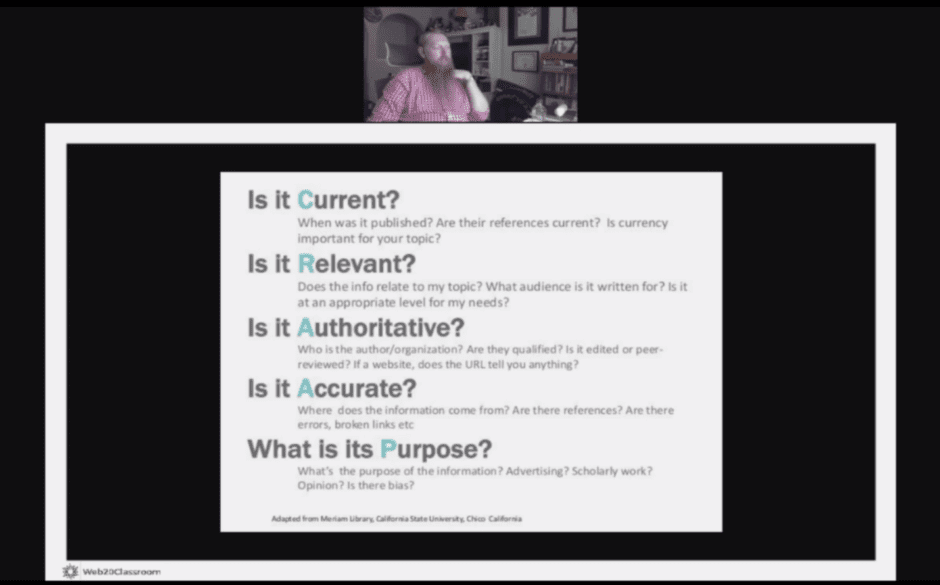
| Evaluation question | What students should examine |
|---|---|
| Who created it? | Author, publisher, expertise, and transparency |
| What is the purpose? | Whether the content informs, persuades, entertains, or sells |
| What evidence is provided? | Data, research, citations, examples, and original documents |
| Can the claim be verified? | Confirmation from independent, relevant sources |
| Is it current? | Publication date, updates, and relevance to the topic |
| Is context missing? | Important qualifications, alternative explanations, or omitted details |
| Is the source appropriate? | Whether its evidence and expertise suit the research task |
Teachers can display this checklist during research lessons and gradually encourage students to use it independently.
It is important to explain that no single answer determines whether a source is trustworthy. A recent publication date, professional design, or recognizable domain does not guarantee accuracy. Students need to consider the full body of evidence.
Adapt Online Information Evaluation to Different Age Groups
Students develop research skills over time. Teachers should introduce evaluation concepts gradually and increase the complexity of activities as learners gain experience.
Elementary School Students
Younger students benefit from clear questions and guided comparisons. Teachers can introduce simple ideas such as identifying an author, checking whether a statement has evidence, and asking a trusted adult when something online seems confusing.
Picture-based activities and short stories can help children recognize the difference between a supported statement and an unsupported claim.
Middle School Students
Middle school students can begin comparing websites, investigating authors, checking publication dates, and identifying persuasive language.
Teachers can model lateral reading and guide students through short source investigations before asking them to work independently or in pairs.
High School Students
Older students can evaluate more complex claims, examine original research, identify conflicts of interest, and assess how evidence is interpreted.
They can also investigate manipulated media, AI-generated content, statistical claims, and differences between reporting, commentary, and advertising.
Research assignments should require students to explain why they trust a source rather than simply listing references.
College and Advanced Learners
Advanced students should evaluate methodological quality, research limitations, author expertise, funding, and the strength of evidence.
They should compare primary and secondary sources, recognize uncertainty, and consider whether the evidence supports the conclusions drawn from it.
These skills are especially important in academic writing, scientific research, and professional decision-making.
Integrate Information Evaluation Across School Subjects
Online information evaluation should not be restricted to computer classes or library lessons. Students encounter digital claims across nearly every academic subject, so teachers can reinforce the same skills in different contexts.
English and language arts: Students can evaluate the evidence in persuasive essays, compare news coverage, and identify misleading summaries.
Science: Students can examine research findings, distinguish scientific evidence from unsupported claims, and investigate the limitations of a study.
History: Students can compare primary sources, examine historical context, and identify differences in how events are interpreted.
Geography and social studies: Students can assess maps, statistics, public reports, and claims about communities or current events.
Mathematics: Students can investigate how graphs, percentages, averages, and statistics may be presented in misleading ways.
When teachers use consistent evaluation methods across subjects, students have more opportunities to practice and transfer their skills to unfamiliar topics.
How Teachers Can Assess Students’ Information Evaluation Skills
Assessment helps teachers determine whether students can apply what they have learned. Instead of asking only for definitions, educators should evaluate students’ reasoning and decision-making.
Useful assessment methods include:
- Source comparison assignments: Students compare multiple sources and explain which is most appropriate for a task.
- Evidence-based explanations: Students support their credibility judgments with specific examples.
- Research journals: Students record how they verified claims and revised their initial conclusions.
- Classroom discussions: Students explain why they trust or question particular statements.
- Practical fact-checking tasks: Students investigate a claim using independent sources and report their findings.
- Short reflection activities: Students identify which evaluation strategies helped them most and what they still find challenging.
Teachers should provide feedback that identifies both strengths and next steps. For example, a student may successfully identify the author but need more practice checking independent evidence.
Repeated low-stakes practice can help students improve without making every evaluation exercise a high-pressure test.
Common Mistakes Students Make When Evaluating Online Information
Recognizing common mistakes helps teachers provide more targeted instruction.
Trusting the First Search Result
Students may assume that the first result is the most accurate. Explain that search rankings do not guarantee credibility, and encourage students to compare relevant sources.
Judging a Website by Its Design
Professional layouts and polished graphics can make weak information look convincing. Students should investigate authorship, evidence, and independent confirmation.
Relying on a Single Source
One source may contain errors, omit important context, or present a limited perspective. Encourage students to look for independent evidence, particularly when a claim is important or controversial.
Confusing Popularity With Accuracy
High engagement does not prove that information is true. Teach students to separate social popularity from verifiable evidence.
Ignoring Publication Dates
Outdated content may no longer reflect current knowledge. Students should check whether information is recent enough for their research question.
Using AI Answers Without Verification
AI-generated responses can contain incorrect details or references. Students should verify important statements and follow school policies for responsible AI use.
By addressing these mistakes directly, teachers can help students replace quick assumptions with more careful research habits.
A Practical Lesson Plan for Teaching Online Information Evaluation
Teachers can introduce these skills in a single lesson and then reinforce them through later assignments.
Lesson objective: Students will evaluate an online claim by investigating its source, checking evidence, and comparing independent information.
Suggested duration: 45–60 minutes.
Materials: A projector or student devices, two or three selected online sources, a source evaluation checklist, and a short response sheet.
Step 1: Introduce the Challenge
Present a surprising but age-appropriate claim related to the current subject. Ask students whether they would trust it immediately and what information they would need before accepting it.
Step 2: Model the Evaluation Process
Think aloud as you investigate the author, publisher, evidence, date, and purpose. Open other sources to demonstrate lateral reading and show how independent information can change an initial judgment.
Step 3: Let Students Investigate
Organize students into pairs or small groups. Give each group a source or claim to examine using the checklist.
Ask them to record their findings and identify any information they could not verify.
Step 4: Compare Findings
Invite groups to explain their conclusions. Encourage students to identify differences in evidence and explain why some sources are more appropriate than others.
Emphasize that a strong conclusion depends on reasoning and evidence, not simply agreeing with the teacher or the majority.
Step 5: Assess Understanding
Ask each student to complete a short exit response:
- What was the main claim?
- What evidence supported or challenged it?
- Which independent sources did you check?
- Would you use the original source in a school assignment? Why or why not?
Review the responses to identify skills that need further instruction.
Frequently Asked Questions
How can teachers teach students to evaluate online information?
Teachers can model source investigation, lateral reading, evidence verification, and comparison of independent sources. Practical activities, research assignments, classroom discussions, and feedback help students apply these strategies to real information.
What are the most important questions students should ask about an online source?
Students should ask who created the content, what its purpose is, what evidence supports its claims, whether independent sources confirm the information, when it was published, and whether important context is missing.
What is lateral reading in digital literacy?
Lateral reading is the practice of leaving an unfamiliar webpage and using other sources to investigate its credibility and claims. It helps students learn about the publisher, verify evidence, and avoid relying solely on a website’s own presentation of itself.
How can students identify misinformation online?
Students can investigate the original source, compare claims with independent evidence, check dates and context, examine images or videos, and look for credible reporting or research. They should avoid sharing claims that remain unverified.
Why is media literacy important for students?
Media literacy helps students understand how digital information is created, presented, and distributed. It supports critical thinking, academic research, responsible communication, and informed decision-making.
How can schools assess online information evaluation skills?
Schools can use source comparison tasks, fact-checking exercises, research journals, written explanations, and classroom discussions. Assessments should focus on students’ ability to explain their judgments using relevant evidence.
Should students use AI tools when researching online information?
AI tools may help students explore topics and generate questions, but their outputs should not be treated as automatically accurate. Students should verify important claims against reliable sources, check references directly, and follow their school’s rules for AI use.
Conclusion
Helping students evaluate online information is an essential part of preparing them for academic success and responsible participation in a digital society. Learners need more than the ability to search for answers. They need to investigate sources, verify claims, recognize bias, compare evidence, and understand when information remains uncertain.
Schools can develop these abilities through explicit instruction, lateral reading, classroom investigations, subject-based research, and regular feedback. When teachers make information evaluation part of everyday learning, students gain repeated opportunities to practice critical thinking and make better-informed decisions.
The ultimate goal is to help students become independent researchers who question information thoughtfully, support their conclusions with evidence, and share digital content responsibly. These habits can benefit them throughout their education and beyond.