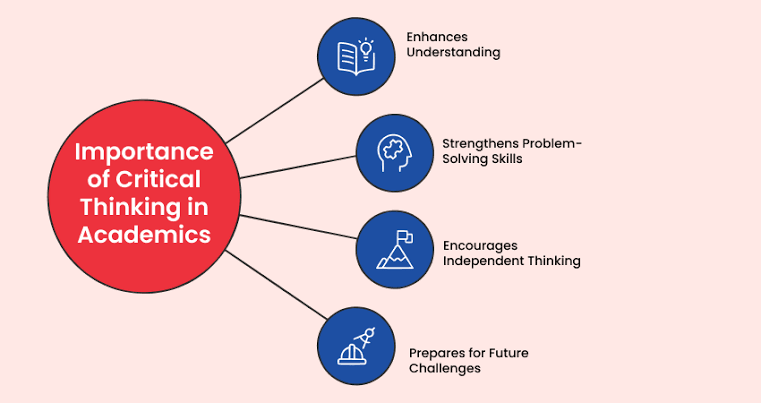

Education is not only about remembering information. A strong education should also teach students how to think, question, analyze, and make reasonable decisions. This ability is commonly known as critical thinking. In a world where people encounter enormous amounts of information every day, critical thinking has become an essential educational skill.
Critical thinking allows students to examine information instead of accepting every statement immediately. A student may read several explanations of the same topic and discover that they contain different opinions or conclusions. Rather than choosing an answer simply because it sounds convincing, a critical thinker asks questions about evidence, sources, assumptions, and reasoning.
Schools can develop critical thinking through classroom discussions. Instead of asking students only to memorize facts, teachers can present problems that require explanation and analysis. For example, after teaching a historical event, a teacher might ask students why different groups experienced the event differently. Such questions encourage learners to consider multiple perspectives and develop their own reasoned conclusions.
Problem-solving activities are another effective way to develop critical thinking. Mathematics, science, technology, and many other subjects naturally provide opportunities for students to solve problems. However, the focus should not always be on reaching the correct answer as quickly as possible. Students should also be encouraged to explain how they reached their answers and consider whether another method could produce the same result.
Reading also plays an important role. When students read articles, books, or reports, teachers can ask them to identify the author’s main argument, supporting evidence, and assumptions. This helps students understand that written information can reflect a particular perspective. Comparing different sources can further develop their ability to evaluate information.
Critical thinking is particularly important in the digital age. Students have access to social media posts, online videos, advertisements, blogs, and countless other forms of content. Some information may be inaccurate or intentionally misleading. Young people need the ability to distinguish between evidence-based information, personal opinion, advertising, and unsupported claims.
Teachers can encourage this skill by asking students to verify sources. A student researching a topic can compare information from multiple reliable sources rather than relying on the first result found online. This process teaches students that research involves evaluation, not simply searching.
Critical thinking also improves communication. Students who understand how to support their ideas with evidence are generally better prepared to participate in discussions and write persuasive assignments. They learn to disagree respectfully and explain why they hold a particular position. This creates a classroom environment where different viewpoints can be discussed without turning every disagreement into an argument.
Another important aspect of critical thinking is recognizing personal assumptions. People naturally have beliefs based on their experiences, culture, education, and environment. Learning to question one’s own assumptions can be challenging, but it is an important part of intellectual development. Students should understand that changing an opinion after discovering stronger evidence is not a weakness. It is often a sign of effective reasoning.
Assessment methods can also influence critical thinking. If students are evaluated mainly through memorization-based tests, they may focus on remembering information temporarily. Assignments involving research, comparison, analysis, and practical problem-solving can provide greater opportunities for deeper learning.
Parents can support critical thinking outside school as well. Everyday activities such as discussing news stories, comparing products, planning household expenses, or solving practical problems can become learning opportunities. Instead of immediately giving children answers, parents can ask questions that encourage them to explain their reasoning.
Critical thinking does not mean doubting everything. It means examining information carefully and reaching conclusions based on reasonable evidence. Students need to understand when evidence is strong, when information is uncertain, and when more research is necessary.
In conclusion, critical thinking is one of the most valuable skills education can provide. It helps students become better researchers, problem-solvers, communicators, and decision-makers. As information continues to grow, the ability to evaluate that information becomes increasingly important. Schools that encourage questioning, analysis, evidence, and thoughtful discussion can prepare students not only for examinations but also for the complex challenges of everyday life.