
Reading is one of the foundations of education. It supports learning across almost every subject and helps students develop language, knowledge, concentration, and analytical abilities. Although digital media has become increasingly common, reading remains an essential skill for academic success and lifelong learning.
One of the most obvious benefits of reading is vocabulary development. Students encounter new words when they read books, articles, stories, and educational materials. Seeing words in different contexts helps learners understand their meanings and learn how to use them correctly. A strong vocabulary can make communication easier and improve writing.
Reading also improves comprehension. Students need to understand information before they can analyze or use it. Regular reading gives learners opportunities to identify main ideas, recognize supporting details, understand relationships between concepts, and make conclusions based on information.
Reading can also support academic performance. Almost every school subject requires students to understand written instructions and educational materials. Science students read explanations and research findings, history students study documents, and mathematics students interpret written problems. Strong reading skills therefore benefit learners across the curriculum.
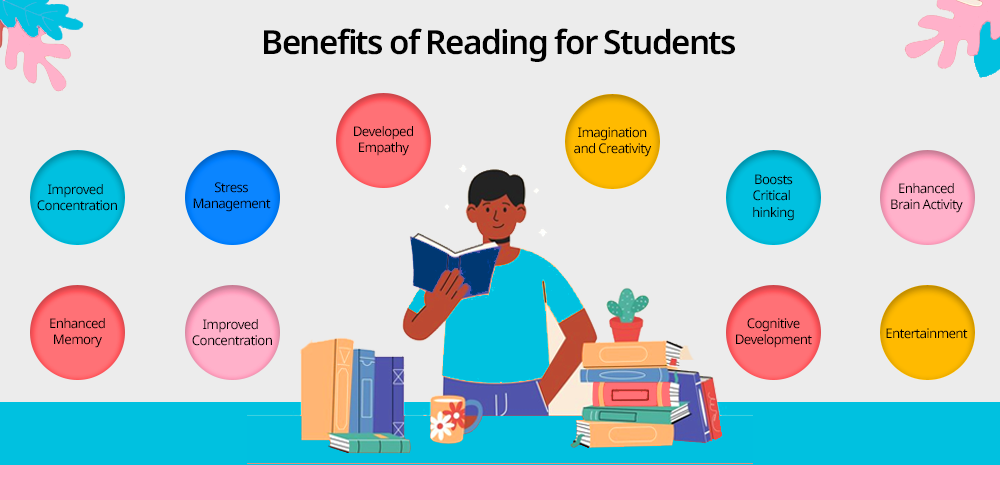
Another important benefit is concentration. Reading requires sustained attention, particularly when students work with longer texts. Developing the ability to focus on a book or article for an extended period can help students manage other academic tasks that require patience and concentration.
Reading also introduces students to different perspectives. Fiction can expose readers to characters and experiences that differ from their own, while nonfiction can introduce new cultures, historical periods, scientific discoveries, and social issues. This exposure can encourage curiosity and help students understand that people may see the same subject differently.
Parents can play an important role in developing reading habits. Children who regularly see adults reading may become more interested in books themselves. Parents can create a comfortable reading space, visit libraries, discuss stories, and allow children to choose age-appropriate books based on their interests.
Schools can encourage reading by providing diverse materials. Not every student enjoys the same type of book. Some may prefer science fiction, while others enjoy biographies, history, sports, technology, or mystery stories. Giving students some choice can make reading feel more engaging rather than simply another school requirement.
Teachers can also connect reading with classroom discussion. After students read a story or article, teachers can ask questions about the author’s ideas, characters, evidence, or conclusions. These discussions can turn reading into an active learning process.
Digital reading has also become common. Students may read on computers, tablets, and electronic readers instead of physical books. Digital formats can provide useful features such as searchable text and adjustable font sizes. However, students should still learn to read carefully and avoid distractions when using digital devices.
Reading difficulties should be identified and addressed early. Some students may struggle with decoding words, vocabulary, fluency, or comprehension. Additional support from teachers and appropriate educational specialists can help students develop stronger skills. Early assistance can prevent small difficulties from becoming larger academic challenges.
Reading also supports writing. Students who read a variety of well-written material can observe how authors organize ideas, introduce arguments, describe events, and use language. These examples can help learners develop their own writing style and understand effective structure.
Beyond school, reading remains valuable throughout life. Adults read instructions, contracts, news reports, professional documents, websites, and educational materials. People who continue reading can keep learning about subjects that interest them and adapt to changes in their personal and professional environments.
In conclusion, reading is much more than a school activity. It develops vocabulary, comprehension, concentration, knowledge, communication, and analytical skills. Schools and families can encourage students to read regularly by providing suitable materials and making reading a positive experience. Whether through traditional books or digital resources, reading remains one of the most important tools for education and lifelong learning.