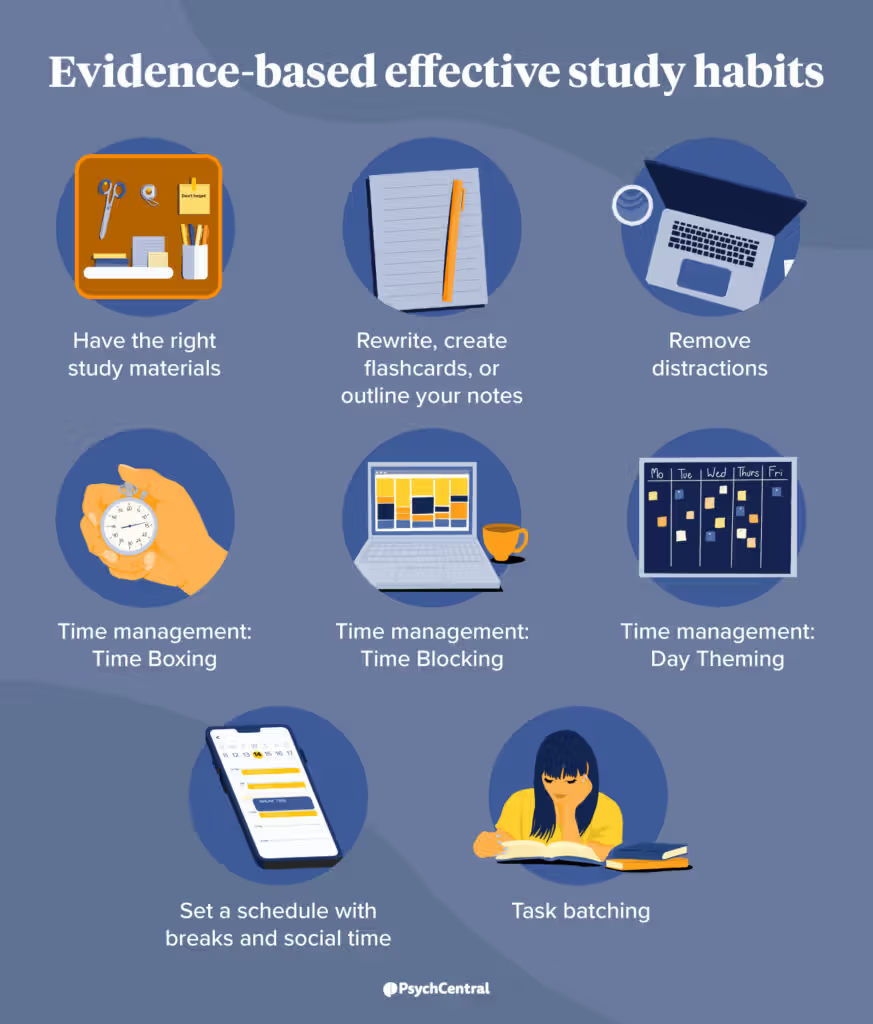

Developing effective study habits for students is one of the most valuable steps toward long-term academic success. Students who learn how to organize their time, review information consistently, manage distractions, and test their understanding can approach schoolwork with greater confidence. These skills also help reduce last-minute stress and make learning more manageable.
However, good study habits do not develop overnight. Students may need guidance to identify ineffective routines, establish realistic goals, and discover which learning strategies work best for them. Teachers and parents can support this process by creating structured learning environments and encouraging students to take responsibility for their progress.
This guide explores practical ways to help students develop better study habits, improve concentration, remember information, and become more independent learners.
Why Are Effective Study Habits Important for Students?
Study habits influence how students prepare for lessons, complete assignments, and retain information over time. Students who follow a consistent routine are often better prepared to manage deadlines and recognize areas where they need additional support.
Effective study habits can help students:
- Improve information retention: Reviewing material regularly helps students revisit important concepts instead of relying on last-minute memorization.
- Manage time effectively: Planning study sessions makes it easier to balance homework, extracurricular activities, and personal responsibilities.
- Build confidence: Understanding how to prepare for assessments can reduce uncertainty and encourage a more positive attitude toward learning.
- Develop independence: Students gradually learn to set goals, monitor progress, and solve academic problems without constant reminders.
- Reduce academic stress: Breaking large assignments into smaller tasks can make challenging workloads feel more achievable.
- Strengthen problem-solving skills: Active learning encourages students to apply knowledge rather than simply repeat information.
Good study habits are not about spending the greatest number of hours studying. They are about using available time purposefully and consistently.
1. Help Students Create a Consistent Study Schedule
One of the most effective ways to develop better study habits is to establish a regular study schedule. When students know when and where they will study, they spend less time deciding what to do next.
Teachers and parents can help students create a routine that fits their school timetable, energy levels, and responsibilities.
Set realistic study times
A schedule should reflect the student’s age, workload, and concentration level. Younger students may benefit from shorter study periods with frequent breaks, while older students may be comfortable with longer sessions.
For example, a student might dedicate 30 minutes to mathematics, take a short break, and then spend another 25 minutes reviewing science notes.
The goal is to create a manageable routine rather than an unrealistic timetable that becomes difficult to maintain.
Plan the week in advance
Encourage students to review upcoming assignments, quizzes, and examinations at the beginning of each week. They can then divide larger tasks into smaller steps and assign time for each activity.
A weekly planner might include:
- Homework and assignment deadlines
- Daily revision sessions
- Upcoming tests and projects
- Time for reading and practice questions
- Breaks and extracurricular activities
A consistent schedule helps students prepare gradually instead of leaving everything until the night before a deadline.
2. Teach Students to Set Clear Study Goals
Students often struggle to study effectively because their goals are too broad. A goal such as “study history” does not explain what needs to be completed or how success will be measured.
Specific goals make study sessions more focused and easier to evaluate.
For example, instead of saying, “I will study science tonight,” a student could set the following goal:
“I will review the water cycle, explain its four main stages without looking at my notes, and answer five practice questions.”
This goal identifies a clear task and provides a way to check understanding.
Break large assignments into smaller tasks
A research project may seem overwhelming when viewed as one large assignment. Students can make it more manageable by dividing it into stages:
- Understand the assignment instructions.
- Choose a topic and develop a research question.
- Organize notes and supporting information.
- Create an outline.
- Write the first draft.
- Revise the work and check the requirements.
- Submit the completed assignment on time.
Completing one stage at a time helps students recognize their progress and maintain motivation.
3. Encourage Active Recall Instead of Passive Reading
Reading the same page repeatedly can make information feel familiar without ensuring that students can remember or explain it independently.
Active recall is a study technique in which students try to retrieve information from memory before checking their notes. It encourages them to identify what they understand and what still requires practice.
Practical ways to use active recall
Students can strengthen their understanding by:
- Closing their textbooks and summarizing a lesson from memory.
- Answering practice questions without checking the answers first.
- Using flashcards to review important terms and definitions.
- Explaining a concept aloud as if teaching someone else.
- Writing down everything they remember about a topic before reviewing their notes.
For example, after learning about the causes of climate change, a student can close the textbook and list the main causes, explain how they influence global temperatures, and then check the list for missing details.
Mistakes are a useful part of this process. When students discover a gap in their knowledge, they can return to the relevant material and practice again.
4. Use Spaced Practice to Improve Long-Term Memory
Spaced practice means reviewing information across multiple study sessions rather than trying to learn everything in one sitting. It is a valuable approach for students preparing for examinations and learning material they will need to remember later.
Instead of studying a chapter for three hours the night before a test, students can divide the work into shorter sessions over several days.
A simple review schedule could look like this:
- Day 1: Learn the new material and identify key concepts.
- Day 2: Review the concepts and answer questions from memory.
- Day 4: Test understanding and revisit difficult sections.
- Day 7: Complete a mixed review of the material.
- Before the test: Practice questions and focus on remaining knowledge gaps.
The exact intervals can vary depending on the difficulty of the subject, the time available, and how well the student remembers the material.
The important principle is to return to information repeatedly over time. Combining spaced practice with active recall can make revision more purposeful and support long-term retention.
5. Help Students Minimize Distractions
Concentration becomes difficult when students are surrounded by interruptions. Mobile notifications, background conversations, unnecessary browser tabs, and cluttered workspaces can repeatedly pull attention away from a task.
A suitable study environment can help students begin work more easily and maintain focus.
Create a dedicated study space
Whenever possible, encourage students to use a quiet, comfortable location with enough light and space for their materials. The study area does not need to be elaborate; it simply needs to support concentration.
Students should keep frequently used materials nearby and remove items that are unrelated to the current task.
Manage digital distractions
Technology can support learning, but it can also interrupt it. Students can try these practical strategies:
- Silence nonessential notifications during study sessions.
- Keep unrelated websites and applications closed.
- Place the phone out of reach when it is not needed.
- Use digital tools for a specific learning purpose.
- Check messages during planned breaks rather than continuously.
Parents and teachers should help students develop self-management skills rather than relying only on strict restrictions. Over time, students need to learn how to recognize distractions and make responsible choices independently.
6. Teach Students to Take Useful Notes
Good notes help students organize information, recognize relationships between ideas, and prepare for later revision. However, copying every sentence from a textbook or presentation may leave little time for thinking about the material.
Students should learn to identify main ideas, supporting details, examples, and questions that need further explanation.
Try different note-taking methods
Outline method: Organize information using headings, subheadings, and bullet points. This works well for structured lessons.
Cornell method: Divide a page into a main notes section, a column for questions or key terms, and a summary area. Students can use the questions for later self-testing.
Mind mapping: Place a central topic in the middle and connect related concepts with branches. This can help students visualize relationships between ideas.
Summary notes: After a lesson, students write a short explanation of the main concepts in their own words.
The best method depends on the subject and the student’s preferences. Encourage students to experiment and choose a system that makes reviewing and understanding information easier.
7. Encourage Students to Practice Difficult Subjects Regularly
Students sometimes avoid challenging subjects because mistakes can feel discouraging. Unfortunately, avoiding difficult material may allow knowledge gaps to grow.
A better approach is to identify specific difficulties and practice them in manageable steps.
For example, a student who struggles with algebra can begin by reviewing the underlying rules, studying one worked example, and then solving a few similar problems independently.
Once the student understands the basic process, they can move toward more challenging questions.
Use mistakes as learning opportunities
After completing an assignment or practice test, students should review incorrect answers and ask:
- Did I misunderstand the question?
- Did I forget an important concept or rule?
- Did I make a calculation or reading error?
- Do I need another example or explanation?
- What will I do differently next time?
Keeping an error log can help students recognize recurring problems and track their improvement.
Teachers should emphasize that mistakes provide information about what to practice next. This encourages persistence and helps students develop a healthier attitude toward challenging work.
8. Teach Time Management and Prioritization
Students may have several assignments due at the same time. Without a clear system for prioritizing tasks, they can spend too much time on easier activities while postponing more demanding work.
Time management helps students decide what requires attention first and how much time to allocate to each responsibility.
Use a simple priority system
Students can categorize tasks according to urgency and importance:
- High priority: An assignment due tomorrow or a test that requires preparation.
- Important but not urgent: A long-term project that should be completed in stages.
- Short routine tasks: Daily reading, reviewing vocabulary, or organizing notes.
- Optional activities: Tasks that can wait until essential responsibilities are complete.
Encourage students to estimate how long each task will take and compare the estimate with the actual time required. This helps them make more realistic plans.
They should also include some flexibility in their schedules because unexpected assignments and difficult topics can require additional time.
9. Build Regular Breaks Into Study Sessions
Studying continuously for long periods can become tiring, particularly when students are working on difficult material. Short breaks provide an opportunity to rest, move around, and return to the task with renewed attention.
One option is to study for 25 minutes and take a five-minute break. After several focused sessions, the student can take a longer break. However, this is only one possible routine; students can adjust the timing according to their age, concentration, and task.
Useful break activities include stretching, walking, drinking water, or getting some fresh air.
Students should avoid letting a short break turn into an extended period of scrolling through social media. A timer can help them return to work as planned.
Breaks should support productive learning rather than create additional pressure to follow a rigid schedule.
10. Support Healthy Sleep and Daily Routines
Effective study habits depend on more than books, schedules, and revision techniques. Students also need routines that support attention, memory, and general well-being.
Adequate sleep is particularly important because tired students may find it harder to concentrate, understand instructions, and manage their emotions.
Parents and educators can encourage students to:
- Maintain a reasonably consistent sleep schedule.
- Avoid relying on all-night study sessions before examinations.
- Eat regular, balanced meals.
- Drink enough water throughout the day.
- Include physical activity in their routines.
- Leave time for relaxation and social activities.
Students should understand that rest is part of effective preparation, not a reward they can only enjoy after finishing every task.
A balanced routine is more sustainable than a schedule that prioritizes studying at the expense of health and well-being.
11. Help Students Evaluate Their Study Methods
Not every study technique works equally well for every task. Students should learn to evaluate whether their methods actually improve understanding rather than relying only on how comfortable studying feels.
For example, a student may feel confident after rereading a chapter several times but struggle to answer questions without the textbook. This suggests that additional retrieval practice may be useful.
After a study session, students can ask themselves:
- Can I explain the main ideas without looking at my notes?
- Which questions did I answer incorrectly?
- Which concepts still confuse me?
- Did I use my time as planned?
- What should I change in my next session?
A weekly review can help students identify successful strategies and adjust ineffective routines.
Teachers can support this process by discussing learning methods, demonstrating how to self-test, and helping students set realistic improvement goals.
12. How Teachers and Parents Can Reinforce Good Study Habits
Students are more likely to maintain productive routines when the adults around them provide consistent guidance and encouragement.
Teachers can demonstrate effective note-taking, provide practice questions, help students break assignments into stages, and explain how to prepare for assessments.
Parents can support these efforts by providing a suitable study environment, helping children organize their schedules, and showing interest in their progress.
Focus on progress rather than perfection
Praise specific actions, such as starting an assignment early, reviewing difficult material, or correcting mistakes independently.
Instead of focusing only on grades, ask students what they learned, which strategy helped them, and what they would improve next time.
Avoid comparing students with siblings or classmates. Each student develops organizational skills and learning strategies at a different pace.
Most importantly, gradually transfer responsibility to the student. Adults can initially help create schedules and reminders, but students should increasingly make their own plans and monitor their progress.
A Simple Weekly Study Routine for Students
A practical routine can help students turn good intentions into consistent action. The following example can be adapted to different school levels and workloads.
| Day | Suggested study activity |
|---|---|
| Monday | Review new lessons, organize notes, and list weekly priorities. |
| Tuesday | Complete homework and practice difficult questions. |
| Wednesday | Use flashcards and active recall to review earlier lessons. |
| Thursday | Work on longer assignments and revisit weak topics. |
| Friday | Complete a short self-test and correct mistakes. |
| Saturday | Review challenging concepts and make progress on projects. |
| Sunday | Prepare materials, check upcoming deadlines, and plan the next week. |
Students do not need to follow this schedule exactly. The objective is to create a realistic balance between new learning, revision, assignments, and rest.
A short, focused session completed consistently is often more manageable than an ambitious plan that is repeatedly abandoned.
Common Study Habit Mistakes Students Should Avoid
Recognizing ineffective routines is an important part of becoming an independent learner.
Cramming at the last minute: Leaving all revision until the day before an examination increases pressure and limits opportunities to revisit difficult concepts.
Relying only on rereading: Reviewing notes can be useful, but students should also practice recalling information and answering questions independently.
Studying without a clear goal: Beginning a session without a specific task can lead to wasted time and unnecessary distractions.
Ignoring incorrect answers: Mistakes reveal knowledge gaps. Students should review them instead of simply checking their scores and moving on.
Multitasking constantly: Switching between schoolwork, messages, and unrelated activities can interrupt concentration.
Creating unrealistic schedules: Planning more work than can reasonably be completed may cause frustration. Study plans should reflect actual commitments and energy levels.
Neglecting sleep and breaks: Excessive study without adequate rest can make routines difficult to maintain.
Replacing these habits with small, consistent improvements can help students develop a more effective approach to learning.
Frequently Asked Questions
What are the most effective study habits for students?
Effective study habits include creating a consistent schedule, setting clear goals, using active recall, reviewing material at spaced intervals, taking useful notes, minimizing distractions, and evaluating progress. Students should choose strategies that match their subjects and learning needs.
How can students improve their study habits at home?
Students can begin by selecting a regular study time, preparing a quiet workspace, organizing assignments, and setting a specific goal for each session. They should also use practice questions, review difficult concepts regularly, and take short breaks when needed.
How long should students study each day?
There is no single ideal study duration for every student. The appropriate amount depends on age, school workload, subject difficulty, and individual needs. Short, focused sessions may be more effective and sustainable than long periods of distracted studying.
Is studying every day better than studying before an exam?
Regular study sessions generally provide more opportunities to review information, identify gaps, and practice retrieval. Spreading learning over time can support longer-term retention and reduce dependence on last-minute cramming.
How can teachers help students develop better study habits?
Teachers can model effective learning strategies, provide structured practice, teach time management, explain how to review mistakes, and encourage students to reflect on their progress. Consistent guidance helps students gradually develop independent learning skills.
How can parents motivate students to study consistently?
Parents can help students establish realistic routines, reduce unnecessary distractions, recognize effort, and discuss progress without creating excessive pressure. Giving students some control over their schedules can also encourage responsibility and independence.
What should students do when their study methods are not working?
Students should identify the specific difficulty, review their results, and try a different approach. For example, they might replace repeated rereading with practice questions, divide a large task into smaller steps, or ask a teacher to explain a confusing concept.
Conclusion
Helping students develop better study habits requires consistent guidance, realistic expectations, and opportunities to practice independent learning. Students benefit when they learn how to organize their time, set clear goals, manage distractions, review information regularly, and evaluate their understanding.
Teachers and parents can reinforce these skills by modeling effective strategies, encouraging students to learn from mistakes, and recognizing steady progress rather than focusing exclusively on grades.
The most effective study routines are not necessarily the longest or most complicated. They are the routines students can maintain and improve over time. By building effective study habits for students into everyday learning, schools and families can help learners become more organized, confident, and prepared for future academic challenges.