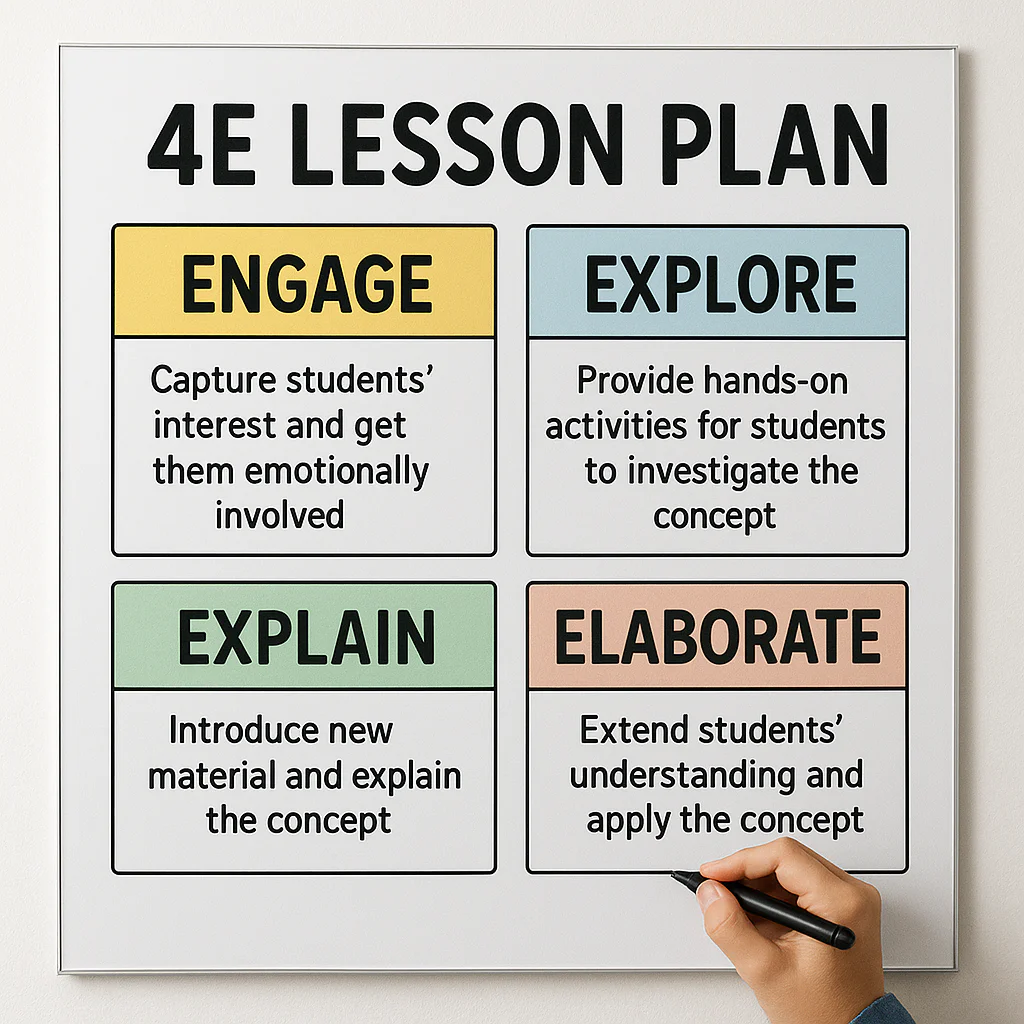

Creating a lesson that captures students’ attention and keeps them actively involved throughout the class is one of the most important skills a teacher can develop. Students are more likely to participate meaningfully when lessons have clear objectives, relevant activities, opportunities to think independently, and regular feedback. A well-designed lesson plan helps teachers organize these elements while ensuring that classroom activities support genuine learning.
An effective student engagement lesson plan goes beyond filling a timetable with lectures, worksheets, and classroom discussions. It considers what students should learn, how they will practise new skills, what might make the material interesting, and how the teacher will determine whether learning has occurred.
This guide explains how teachers can design engaging lesson plans, select appropriate instructional activities, support different learning needs, and evaluate whether their teaching methods are helping students succeed.
What Is a Student Engagement Lesson Plan?
A student engagement lesson plan is a structured teaching plan designed to encourage learners to participate actively in the learning process. It combines clear learning objectives, appropriate instructional methods, meaningful classroom activities, and assessment techniques that help teachers monitor student understanding.
Student engagement can take several forms:
- Behavioral engagement: Students participate in activities, follow classroom routines, and make an effort to complete learning tasks.
- Cognitive engagement: Students think critically, solve problems, make connections, and work to understand challenging concepts.
- Emotional engagement: Students show interest, feel supported, and develop a sense of belonging in the classroom.
An effective lesson plan considers all three dimensions. Students may appear busy without understanding the material, while others may be thinking carefully even when they are not speaking frequently.
Teachers should therefore plan activities that encourage meaningful participation rather than simply keeping students occupied.
Research on proactive lesson planning highlights strategies such as whole-class response systems, movement, visual supports, and student choice as practical ways to promote engagement and reduce avoidable classroom disruptions. <Cite refs={[“turn731587search2″,”turn731587search5”]}/>
Why Student Engagement Matters in Lesson Planning
Engagement influences how students interact with information, respond to challenges, and develop their understanding. When lessons provide opportunities to think, practise, and receive feedback, teachers can identify learning difficulties and respond before students fall behind.
1. Encourages Active Participation
Students who have regular opportunities to answer questions, discuss ideas, complete tasks, and demonstrate understanding are more actively involved in lessons.
Teachers can encourage participation through short discussions, collaborative exercises, written responses, practical demonstrations, and individual problem-solving activities.
2. Supports Better Understanding
Engaging activities should help students process the lesson’s main ideas. For example, students learning about fractions might use visual models and solve practical problems rather than only copy definitions from a board.
The activity gives students an opportunity to apply the concept and reveal whether they understand it.
3. Helps Teachers Identify Learning Gaps
Students do not always express confusion directly. A carefully designed lesson includes questions, quick assessments, and opportunities for students to demonstrate their thinking.
Teachers can use this information to explain a difficult concept again, provide additional examples, or move students toward more challenging work.
4. Creates a Positive Classroom Environment
Lessons with clear expectations, manageable activities, and predictable routines can reduce unnecessary confusion. Students are more likely to participate when they understand what to do and feel comfortable asking questions.
5. Supports Different Learning Needs
Students vary in their prior knowledge, language skills, confidence, and support needs. A well-designed lesson includes appropriate scaffolding, different ways to participate, and opportunities for students to progress toward the same learning objective.
1. Start With Clear and Specific Learning Objectives
The first step in designing an engaging lesson is deciding what students should know or be able to do by the end of the session.
Learning objectives provide direction for the teacher and help students understand the purpose of classroom activities. Without clear objectives, lessons can become a series of interesting tasks that do not build toward meaningful learning.
For example, a broad objective such as “understand plants” is difficult to assess. A more specific objective might be “identify the main parts of a flowering plant and explain the function of each part.”
The second objective gives the teacher a clearer direction for selecting activities and assessing understanding.
When preparing objectives, consider the following questions:
- What knowledge or skill should students develop?
- What should students be able to demonstrate independently?
- What prior knowledge will they need?
- How will the teacher recognize successful learning?
- What misconceptions might students have?
Share the objective at the beginning of the lesson using language appropriate for the students’ age and reading level.
Teachers can also provide success criteria that explain what a successful response or completed task should include.
For example, students writing a persuasive paragraph might need a clear opinion, supporting reasons, and a concluding sentence.
Clear objectives make it easier to select engaging activities because every part of the lesson has a defined purpose.
2. Begin With an Interesting Lesson Starter
The opening minutes of a lesson provide an opportunity to activate prior knowledge and introduce the topic in an interesting way.
A useful lesson starter should connect directly to the learning objective. It should encourage curiosity or help students recall information they will need during the lesson.
Effective lesson starters include:
A thought-provoking question: Ask students to explain why ice melts faster in one location than another.
A surprising observation: Show a scientific demonstration and invite students to predict the result.
A short problem: Present a mathematics question that requires students to use a previously learned skill.
A visual prompt: Display a photograph, diagram, map, or illustration related to the topic.
A quick recall activity: Ask students to write down three things they remember from the previous lesson.
A real-world scenario: Present a problem that students might encounter outside the classroom.
For example, a teacher introducing persuasive writing could show two advertisements for similar products and ask students which one is more convincing and why.
Students can briefly discuss their ideas before the teacher introduces persuasive techniques.
Keep the opening activity short enough to leave adequate time for instruction and practice. The purpose is to prepare students for learning, not to create an entertaining activity unrelated to the main objective.
3. Break the Lesson Into Manageable Sections
Long periods of uninterrupted explanation can make it difficult for students to maintain attention, particularly when the material is unfamiliar or complex.
A well-structured lesson alternates between explanation, demonstration, student practice, discussion, and assessment. These transitions give students different ways to process information while keeping the lesson focused.
A practical lesson structure includes:
- Introduction: Explain the objective and connect it to prior knowledge.
- Teacher explanation: Introduce the main concept in manageable steps.
- Modeling: Demonstrate how to apply the concept.
- Guided practice: Work through an example with student participation.
- Independent or collaborative practice: Let students apply what they have learned.
- Assessment: Check understanding using questions or a short task.
- Conclusion: Review the key idea and identify the next learning step.
The length of each section depends on the students’ age, subject, lesson duration, and complexity of the material.
For a younger class, shorter activities with clear transitions may be appropriate. Older students may benefit from longer discussions, investigations, or extended problem-solving tasks.
Teachers should also plan transitions in advance. Clear instructions, prepared materials, and established classroom routines help prevent students from losing valuable learning time.
4. Use Interactive Teaching Methods
Interactive teaching gives students opportunities to respond to ideas, explain their thinking, and practise skills rather than passively receive information.
The method should match the lesson objective. An activity is not automatically effective simply because it involves movement, discussion, or technology.
Useful interactive methods include:
- Think-pair-share discussions.
- Whole-class question-and-answer activities.
- Group problem-solving.
- Concept mapping.
- Practical demonstrations.
- Structured debates.
- Student presentations.
- Short written explanations.
For example, during a history lesson, students might examine two accounts of the same event, identify differences, and discuss why the sources present different perspectives.
In mathematics, students could solve a problem individually and then compare their methods with a partner.
Teachers should explain the purpose of the activity, provide clear instructions, and establish how students will share their findings.
It is also important to provide time for individual thinking. If students are immediately placed into groups, some may rely on others without developing their own understanding.
A combination of individual work, paired discussion, and teacher-guided explanation helps ensure that engagement supports learning rather than replacing it.
5. Connect Classroom Activities to Real-Life Situations
Students may find it easier to understand a concept when they can see how it applies to familiar situations.
Real-world examples make abstract ideas more concrete and help learners recognize why the material matters.
Teachers can incorporate practical contexts into almost any subject.
In mathematics, students might calculate shopping discounts, compare prices, or work out the cost of organizing a class event.
In science, students could investigate how plants grow, compare materials, or observe changes in temperature.
In language lessons, students might write a letter, prepare a short interview, or create instructions for completing a task.
In geography, students could study local weather patterns, interpret maps, or compare different environments.
In social studies, learners might examine a community issue and discuss possible solutions.
The activity should remain aligned with the lesson objective. If students are learning percentages, for example, calculating a discount can provide a useful context for practising the mathematical procedure.
After completing the task, ask students to explain the concept they used and how they reached their answer.
This reflection helps connect the practical activity to the underlying knowledge and skills.
6. Include Opportunities for Student Choice
Giving students appropriate choices can increase their sense of ownership and encourage them to participate more actively.
Choice does not mean removing learning objectives or allowing every student to ignore required tasks. Instead, teachers can provide different ways to practise the same skill or demonstrate understanding.
For example, after studying a historical topic, students might choose to create a written summary, prepare a short presentation, or construct a timeline with explanatory notes.
In a science lesson, students could choose between several questions for a structured investigation, provided each question addresses the required learning goals.
Teachers can also offer choices in reading materials, practice questions, or the order in which students complete selected tasks.
When planning student choice, consider these principles:
- Keep the learning objective consistent.
- Make the options appropriate for the students’ abilities.
- Explain the requirements for successful completion.
- Provide enough guidance to prevent unnecessary confusion.
- Ensure that all options require meaningful learning.
Too many choices can sometimes overwhelm students. A small number of clearly explained options is often easier to manage.
Well-designed choices give students a voice in the learning process while maintaining appropriate academic expectations.
7. Use Visuals, Demonstrations, and Learning Materials
Visual and practical resources can help teachers explain information that may be difficult to understand through verbal explanation alone.
Depending on the subject, useful resources include diagrams, charts, photographs, physical objects, maps, models, manipulatives, and demonstrations.
For example, a teacher explaining the water cycle might use a labeled diagram alongside a simple demonstration of evaporation and condensation.
A mathematics teacher could use fraction strips or paper shapes to show how different fractions relate to one another.
A geography lesson might use maps and graphs to help students interpret population patterns or climate data.
Visual materials should be clear, accurate, and directly connected to the learning objective. Too many decorative images or unrelated details can distract students from the main idea.
Teachers should explain how to interpret a visual rather than assuming students will understand it independently.
Practical resources should also be accessible and safe for the intended age group. If students have different sensory, language, or accessibility needs, alternative ways of accessing the material may be necessary.
The purpose of using resources is to clarify concepts and support learning, not simply to make the lesson look more attractive.
8. Plan for Different Student Needs
An engaging lesson should provide meaningful opportunities for students with different levels of prior knowledge, confidence, and support needs.
Teachers do not need to design a completely separate lesson for every student. Instead, they can maintain a shared learning objective while adjusting the level of guidance, the complexity of practice, and the resources available.
Practical differentiation strategies include:
- Providing worked examples before independent tasks.
- Using vocabulary lists or sentence starters when appropriate.
- Offering additional guided practice to students who need support.
- Preparing extension questions for students who master the main objective.
- Breaking complex tasks into smaller steps.
- Providing written and spoken instructions.
- Allowing appropriate ways to demonstrate understanding.
- Using accessible materials and assistive tools when needed.
For example, during a lesson on persuasive writing, some students might use a structured paragraph outline, while others independently organize a more complex argument using evidence from multiple sources.
Both groups can work toward stronger persuasive writing, but the level of support differs.
Teachers should use assessment evidence to decide which students need additional guidance and which are ready for greater challenge.
Differentiation should remain flexible. Students may need different types of support for different topics, and assistance should be adjusted as their understanding develops.
9. Build Formative Assessment Into the Lesson
Formative assessment helps teachers understand what students are learning while the lesson is still in progress. It provides information that can guide explanations, practice activities, and follow-up support.
A systematic review of research on formative assessment identified teacher knowledge, assessment skills, collaboration, and the ability to interpret learning evidence as important factors in effective classroom practice. <Cite refs={[“turn731587search3″,”turn731587search6”]}/>
Teachers can build simple assessment activities into each stage of the lesson.
During the introduction: Ask students to recall relevant prior knowledge.
During explanation: Pause to ask a targeted question and invite students to explain their reasoning.
During guided practice: Review responses and identify common errors.
During independent work: Observe how students approach the task and where they become confused.
At the end of the lesson: Use an exit ticket, short quiz, or written reflection to check progress.
For example, after teaching a new multiplication strategy, a teacher could ask students to solve one problem and explain the steps they used.
The responses may reveal whether students understand the process or are simply copying an example.
Teachers should use the evidence to decide what happens next. If many students are confused, the concept may need to be explained again. If most students demonstrate understanding, the class may be ready for more challenging applications.
Assessment is most valuable when it informs instructional decisions rather than simply adding another task to the lesson.
10. Provide Clear and Useful Feedback
Feedback helps students understand what they have done successfully and what they should do next.
Effective feedback is specific, connected to the learning objective, and practical enough for students to apply.
For example, telling a student “Try harder” does not explain what needs improvement. A more useful comment might be, “Your answer identifies the correct result. Show the calculation steps so the reader can follow your reasoning.”
Teachers can provide feedback verbally during practice, through written comments, during short conferences, or by using peer-review activities with clear criteria.
A useful feedback process includes:
- Identifying what the student has done well.
- Explaining a specific error or area for improvement.
- Suggesting a practical next step.
- Giving the student time to revise or practise.
- Checking whether the feedback has helped.
Feedback should be manageable for both teachers and students. Correcting every minor error at once can make improvement difficult to focus on.
Instead, prioritize the mistakes most closely connected to the learning objective.
Students should also learn how to use feedback. Teachers can model how to revise an answer, improve a paragraph, or correct a calculation based on specific guidance.
When feedback leads to action, it becomes part of the learning process rather than simply a comment on completed work.
11. Encourage Collaboration With Clear Group Roles
Group activities can help students exchange ideas, explain their reasoning, and learn how to work with others. However, group work is not automatically effective. Without clear expectations, some students may complete most of the work while others remain passive.
Teachers should choose collaborative tasks that genuinely benefit from discussion or shared problem-solving.
Before students begin, explain the objective, expected outcome, available time, and standards for participation.
For example, during a science investigation, group members might take responsibility for recording observations, managing materials, measuring results, and presenting conclusions.
Roles should be appropriate for the task and should not permanently restrict particular students to the same type of work.
Teachers can monitor progress by listening to discussions, asking students to explain their decisions, and checking individual understanding after the activity.
It is also helpful to include individual accountability. Each student might submit a short reflection, answer a follow-up question, or explain one part of the group’s findings.
This approach allows students to benefit from collaboration while ensuring that each learner remains responsible for understanding the material.
12. Use Movement and Short Activity Changes Purposefully
Students may benefit from changes in activity, especially during longer lessons. Short opportunities to stand, move, organize materials, or complete a hands-on task can provide variety and help maintain participation.
Movement should have a clear purpose and fit the classroom environment.
Examples include:
- Moving to a position that represents an answer to a question.
- Visiting stations with different practice tasks.
- Sorting cards into categories.
- Conducting a supervised practical investigation.
- Completing a short movement break between demanding activities.
- Working with physical models or manipulatives.
For example, during a language lesson, students might sort vocabulary cards by meaning before using the words in sentences.
In mathematics, they could move between stations to practise different types of problems.
Teachers should explain procedures in advance and consider mobility, accessibility, safety, and available space.
Movement is not necessary in every lesson. A quiet reading activity or an extended writing task may be more appropriate when students need sustained concentration.
The goal is to select activity formats that support the learning objective and help students remain meaningfully involved.
13. Use Educational Technology Only When It Adds Value
Digital tools can support engagement by offering interactive practice, visual demonstrations, collaborative documents, and quick ways to check understanding.
However, technology should be used because it improves the learning experience, not simply because it is available.
Useful classroom applications include:
- Digital quizzes for checking understanding.
- Interactive diagrams for explaining complex processes.
- Shared documents for collaborative writing.
- Virtual simulations for exploring scientific concepts.
- Educational videos followed by structured questions.
- Digital presentations that help students communicate their findings.
For example, a teacher might use an interactive geography map to examine population distribution and then ask students to explain patterns they observe.
Students should still discuss the information, interpret evidence, and connect their observations to the lesson objective.
Teachers should consider internet reliability, device access, accessibility, privacy, and the quality of digital content.
A technology-based activity should also have a non-digital alternative when necessary. Students should not be excluded from meaningful participation because they lack access to a device or reliable internet connection.
When used thoughtfully, technology can complement explanation, practice, and feedback. It should not replace the teacher’s role in guiding learning.
14. End the Lesson With a Meaningful Review
The conclusion helps students organize what they have learned and gives teachers a final opportunity to check understanding.
A strong lesson ending returns to the learning objective and asks students to demonstrate or summarize their progress.
Useful closing activities include:
- Writing three important points from the lesson.
- Answering one question that tests the main objective.
- Explaining a concept to a partner.
- Correcting a common misconception.
- Completing an exit ticket.
- Identifying one question they still have.
- Reflecting on how they solved a problem.
For example, after a lesson on persuasive writing, students might identify the main argument in their own paragraph and point out the evidence they used to support it.
Teachers can review responses to determine whether the lesson objective was achieved and which concepts may need further attention.
The ending should not be rushed every day to make room for additional activities. A short, focused review can provide valuable evidence about student learning.
It also helps students connect the current lesson with future topics, making learning more coherent over time.
15. Review and Improve Your Lesson Plans
Effective lesson planning is an ongoing process. Teachers should review what happened during the lesson and use the information to improve future instruction.
A lesson may have appeared well organized on paper but still leave students confused, or an activity may take longer than expected. Reflection helps teachers identify these issues and adjust their plans.
After the lesson, consider the following questions:
- Did students achieve the intended learning objective?
- Which activities generated meaningful participation?
- Where did students struggle?
- Were the instructions clear?
- Did the lesson provide enough time for practice?
- Were different learning needs supported appropriately?
- Which assessment responses revealed misconceptions?
- What should be changed before teaching the lesson again?
Teachers can use student work, exit tickets, observations, and feedback to answer these questions.
For example, if students enjoyed a group activity but could not independently solve the related problems afterward, the lesson may need more individual practice.
Similarly, if a task was too easy for many students, the next lesson could include more challenging applications.
Reflective planning does not require rewriting every lesson from the beginning. Small, evidence-informed changes can gradually improve instructional quality.
Example of an Engaging 45-Minute Lesson Plan
The following example demonstrates how teachers can combine clear objectives, interactive activities, practice, and assessment within a single lesson.
Subject: Science
Topic: The Water Cycle
Learning objective: Students will identify the main stages of the water cycle and explain how water moves between them.
Success criteria: Students can identify evaporation, condensation, and precipitation and describe the sequence using a labeled diagram.
| Time | Lesson activity | Purpose |
|---|---|---|
| 0–5 minutes | Ask students what happens to a puddle after a sunny day | Activate prior knowledge |
| 5–12 minutes | Explain the main stages using a clear diagram | Introduce key concepts |
| 12–20 minutes | Model how water moves through the cycle and ask targeted questions | Check understanding |
| 20–30 minutes | Students work in pairs to label a water-cycle diagram and explain the stages | Encourage application and discussion |
| 30–38 minutes | Students independently draw and explain the cycle | Check individual understanding |
| 38–43 minutes | Review common errors and provide corrective feedback | Address misconceptions |
| 43–45 minutes | Students complete an exit question | Identify next learning steps |
The teacher can adapt this structure to different grade levels. Younger students may need picture prompts and vocabulary support, while older students may investigate how temperature affects evaporation or explain how the water cycle influences local weather.
The important feature is the alignment between the objective, activities, and assessment. Every stage contributes to the intended learning outcome.
Common Lesson Planning Mistakes to Avoid
Even experienced teachers can encounter difficulties when planning lessons. Recognizing common mistakes can help make classroom activities more effective.
Planning Too Many Activities
A lesson packed with tasks may leave insufficient time for explanation, practice, and reflection. Prioritize activities that contribute directly to the learning objective.
Focusing on Entertainment Instead of Learning
Games and creative activities can be useful, but they should develop or assess the intended knowledge and skills.
Giving Unclear Instructions
Students may lose time when they do not understand what to do. Explain the task, demonstrate an example when necessary, and clarify the expected outcome.
Ignoring Prior Knowledge
Students may struggle with a new concept if they lack the foundations needed to understand it. Use a short starter or diagnostic question to identify gaps.
Using the Same Activity Format Every Time
Different objectives may require different teaching approaches. Combine explanation, practice, discussion, independent work, and assessment as appropriate.
Failing to Check Understanding
A lesson may appear successful while important misconceptions remain. Include opportunities for students to demonstrate their understanding throughout the session.
Forgetting to Plan for Different Needs
Students may require additional scaffolding or greater challenge. Prepare suitable support and extension activities in advance.
Avoiding these mistakes helps teachers create lessons that are organized, flexible, and focused on meaningful student progress.
A Practical Checklist for an Engaging Lesson Plan
Before teaching a lesson, use this checklist to review the essential elements.
- Define a clear learning objective.
- Establish success criteria students can understand.
- Identify relevant prior knowledge.
- Prepare an engaging and relevant lesson starter.
- Organize the lesson into manageable sections.
- Include opportunities for active participation.
- Choose resources that support the learning objective.
- Plan guided and independent practice.
- Provide appropriate support and extension tasks.
- Include formative assessment throughout the lesson.
- Prepare clear feedback and follow-up activities.
- Allow time for a final review or exit ticket.
- Reflect on student responses after the lesson.
This checklist can be adapted to different subjects, grade levels, and lesson durations.
Conclusion
Designing lessons that keep students engaged requires careful planning, clear learning objectives, meaningful activities, and regular checks for understanding. Teachers should consider not only how to capture attention but also how to help students think deeply, practise new skills, and demonstrate what they have learned.
An effective student engagement lesson plan combines structured instruction with opportunities for participation, collaboration, student choice, practical application, and feedback. It also provides flexibility so teachers can respond when students need additional support or are ready for more challenging work.
The best lesson plans are not necessarily the most complicated. They are the ones in which every activity serves a clear purpose, students understand what they are working toward, and teachers use classroom evidence to guide the next step.
By reviewing lessons regularly and making thoughtful improvements, educators can create a more supportive learning environment and give students stronger opportunities to participate, develop confidence, and succeed academically.
